
Nvidia CEO Jensen Huang Urges Balanced AI Regulation to Support Innovation and Global Competitiveness
Introduction
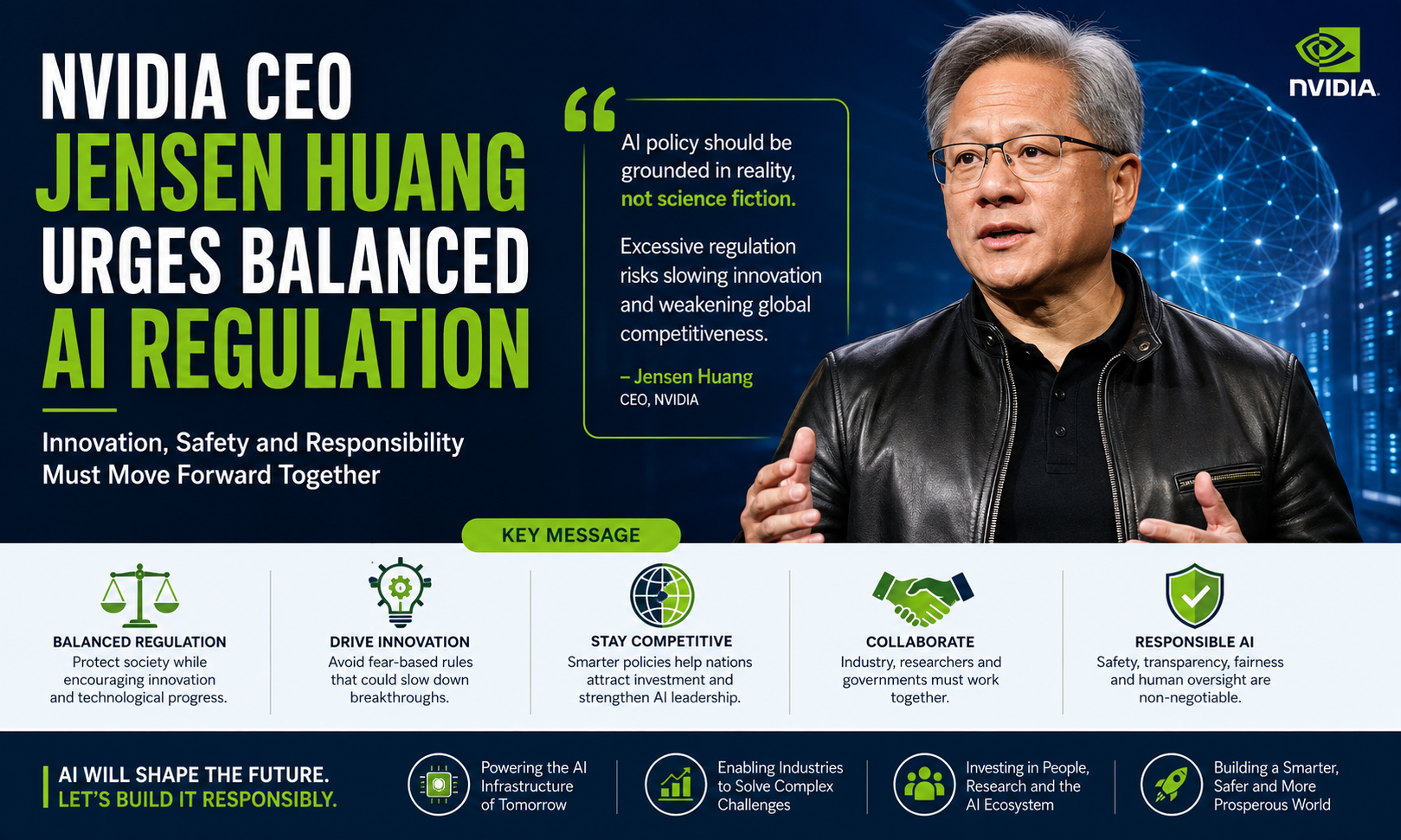
Artificial intelligence has become one of the most transformative technologies of the modern era, influencing industries ranging from healthcare and manufacturing to finance, education, and transportation. As AI capabilities continue to expand, governments around the world are working to establish regulations that promote safety, transparency, and accountability. At the same time, technology leaders are emphasizing the importance of ensuring that these regulations do not unintentionally slow innovation. Nvidia CEO Jensen Huang recently highlighted the need for a balanced approach to AI regulation. Speaking about the future of artificial intelligence, Huang stressed that policymakers should carefully consider both the opportunities and the risks associated with AI while avoiding rules that could hinder technological progress. His comments reflect a growing discussion among governments, researchers, and businesses about how to create policies that encourage responsible AI development without limiting its potential.
AI Is Becoming a Core Economic Driver
Artificial intelligence is no longer limited to research laboratories or technology companies. It has become an essential tool for businesses of all sizes. Organizations are using AI to automate repetitive tasks, improve customer service, analyze large datasets, optimize supply chains, and develop innovative products.
According to Huang, AI has evolved into critical infrastructure similar to electricity or the internet. Countries investing in AI research, computing power, and skilled professionals are expected to gain significant economic advantages over the coming decades. This growing importance makes thoughtful regulation more important than ever.
Innovation Requires Practical Regulations
Huang emphasized that regulation should protect society while allowing innovation to flourish. Excessively restrictive policies could discourage startups, reduce investment, and slow technological advancement.
A balanced regulatory framework should:
- Encourage responsible AI development.
- Protect user privacy and security.
- Support transparency in AI systems.
- Prevent misuse of advanced technologies.
- Allow researchers and businesses to continue innovating.
By maintaining this balance, governments can foster both public trust and technological progress.
Avoiding Fear-Based Policymaking
One of Huang’s key messages was that AI policies should be based on scientific evidence and real-world understanding rather than exaggerated fears. Public discussions about artificial intelligence often include dramatic predictions about machines replacing humans or creating uncontrollable risks.
While acknowledging that AI presents genuine challenges, Huang suggested that regulations should focus on practical issues such as safety, accountability, cybersecurity, and ethical deployment instead of speculative scenarios.
Evidence-based policymaking can help create regulations that are effective without unnecessarily limiting innovation.
Global Competition Is Accelerating
Countries worldwide are investing billions of dollars in AI infrastructure, semiconductor manufacturing, cloud computing, and research initiatives. The competition to become a global AI leader is intensifying.
Governments in North America, Europe, and Asia are introducing national AI strategies designed to strengthen domestic industries and attract technology investment.
Huang believes balanced regulations can improve a country’s competitiveness by encouraging businesses to build AI products locally while maintaining high standards for safety and responsibility.
AI Infrastructure Is Essential
Nvidia has become one of the world’s leading providers of AI computing hardware. Its graphics processing units (GPUs) power many of today’s most advanced AI models, scientific research projects, autonomous vehicle systems, and enterprise applications.
Huang frequently describes AI infrastructure as the foundation for future innovation. Data centers equipped with powerful AI chips enable businesses and researchers to train increasingly sophisticated machine learning models.
As AI adoption expands, governments are also investing in national computing infrastructure, recognizing that access to advanced computing resources will be essential for economic growth.

Supporting Startups and Research
Balanced AI regulations can play a major role in helping startups and research institutions succeed.
Young companies often develop breakthrough technologies but may struggle if compliance requirements become overly expensive or complex. Universities and research organizations also benefit from regulatory environments that encourage experimentation while maintaining ethical standards.
Creating clear and practical rules allows innovators to focus on solving real-world problems instead of navigating unnecessary regulatory uncertainty.
Responsible AI Development
Although Huang advocates for flexible regulations, he also recognizes the importance of responsible AI development.
Organizations building AI systems should prioritize:
- Data privacy
- Model transparency
- Security protections
- Fairness and bias reduction
- Human oversight
- Risk management
Responsible development helps increase public confidence while reducing the likelihood of harmful outcomes.
Industry and Government Collaboration
Effective AI governance requires cooperation between governments, technology companies, academic researchers, and independent experts.
Huang has encouraged policymakers to consult engineers, scientists, and AI practitioners when developing regulations. Industry expertise can help governments better understand rapidly changing technologies and create rules that remain relevant over time.
Public-private collaboration can also accelerate the development of technical standards and best practices for AI deployment.
AI Will Transform Every Industry
Artificial intelligence is expected to reshape nearly every sector of the global economy.
Healthcare organizations are using AI to improve diagnostics and accelerate drug discovery. Manufacturers are optimizing production with predictive maintenance and robotics. Financial institutions rely on AI for fraud detection and risk analysis. Retailers personalize customer experiences using intelligent recommendation systems.
As adoption expands, the need for thoughtful governance becomes increasingly important.
Education and Workforce Development
The rapid growth of AI is creating demand for skilled professionals in machine learning, software engineering, cybersecurity, semiconductor design, cloud computing, and data science.
Huang has repeatedly emphasized the importance of investing in education and workforce development to prepare future generations for AI-driven careers.
Governments can complement AI regulation by supporting educational programs, technical training, and research initiatives that help workers adapt to changing job markets.
Building Public Trust
Public confidence plays a crucial role in AI adoption.
Transparent policies, ethical development practices, and strong security standards help build trust among businesses, consumers, and governments. Balanced regulations can reassure the public that AI technologies are being developed responsibly while allowing innovation to continue.
Companies that prioritize responsible AI practices are also more likely to earn customer confidence and maintain long-term success.
Conclusion
Artificial intelligence will continue evolving rapidly over the next decade. Advances in computing power, software, robotics, and data infrastructure will unlock new applications that are difficult to predict today.
Jensen Huang’s call for balanced AI regulation reflects the growing recognition that governments must encourage innovation while protecting society from genuine risks. Rather than viewing regulation and innovation as opposing forces, policymakers can design frameworks that support both objectives.
The future of AI will depend not only on technological breakthroughs but also on thoughtful governance, international collaboration, continued investment in research, and a shared commitment to responsible development. By adopting practical, evidence-based regulations, countries can strengthen their AI ecosystems, encourage entrepreneurship, and ensure that artificial intelligence delivers lasting economic and social benefits for people around the world.