




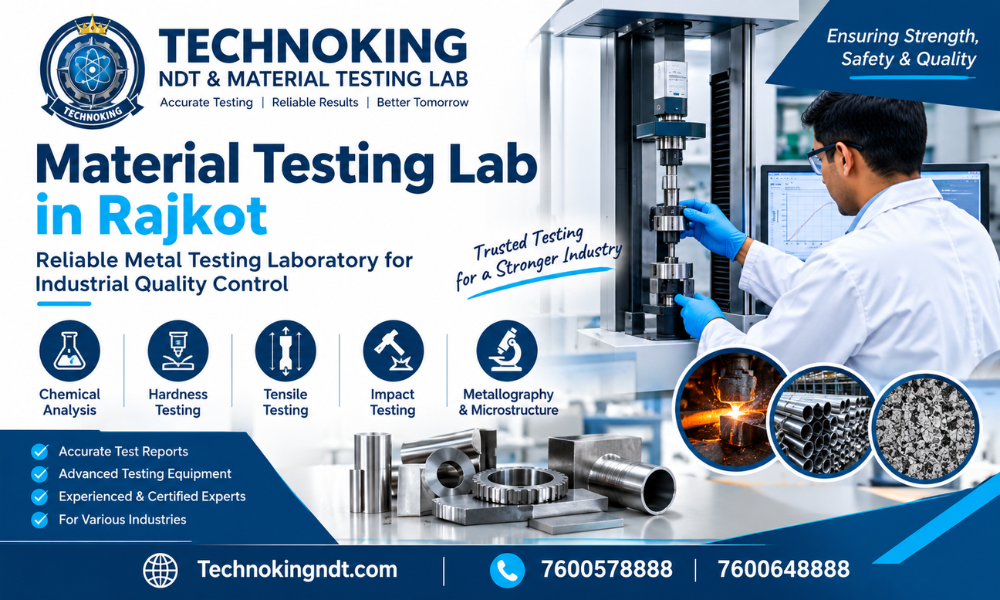
Material Testing Lab in Rajkot – Reliable Metal Testing Laboratory for Industrial Quality Control
Introduction
Material quality and strength are essential factors in manufacturing, construction, engineering, fabrication, and industrial production. Every component used in an industrial application must meet suitable quality standards to ensure reliable performance, durability, and safety. Material testing helps manufacturers evaluate the physical, mechanical, and chemical properties of materials before they are used in production or delivered to customers. Proper testing also helps identify defects, reduce material failures, and maintain consistent product quality. Rajkot is an important industrial hub in Gujarat, known for its engineering industries, foundries, machine manufacturers, casting units, and metal component production. Businesses in these sectors require dependable testing solutions to verify material properties and maintain quality control throughout their manufacturing processes. Professional testing facilities support industries by providing technical evaluation, inspection, and material analysis for a wide range of applications.
Importance of Material Testing in Industrial Applications
Material testing plays a significant role in determining whether a material is suitable for its intended purpose. Different industrial applications require specific mechanical properties, strength levels, and material compositions. Testing helps manufacturers understand these characteristics and make informed decisions about material selection and product quality.
A professional Material Testing Lab in Rajkot can help industrial businesses evaluate materials and identify potential quality issues before they affect finished products. These assessments are particularly important for components exposed to pressure, heavy loads, friction, temperature variations, or demanding operating conditions.
Material testing offers several benefits:
- Quality assurance: Confirms whether materials meet specified requirements.
- Improved reliability: Helps reduce the risk of premature component failure.
- Defect identification: Supports the detection of material inconsistencies and weaknesses.
- Manufacturing control: Helps maintain consistent quality across production batches.
- Compliance support: Provides test results that can support applicable standards and customer specifications.
- Cost reduction: Helps minimize rejection, rework, and material wastage.
By incorporating suitable testing procedures into production workflows, manufacturers can improve operational efficiency and deliver more reliable products.
Services Offered by a Material Testing Laboratory
Material testing includes different procedures designed to evaluate the characteristics and performance of metals, alloys, and other engineering materials. The appropriate test depends on the material type, product design, application, and relevant technical requirements.
A reliable Material Testing Laboratory in Rajkot can support industrial quality control through testing procedures selected according to customer requirements and applicable standards.
- Mechanical Testing
Mechanical testing evaluates how a material responds to applied forces and operating conditions. These tests help determine whether a material has the strength and mechanical properties required for its intended application.
Common mechanical tests include tensile testing, hardness testing, impact testing, and other assessments depending on the laboratory’s available equipment and scope.
The results help engineers understand material behavior and select suitable materials for industrial components, machinery, fabricated structures, and engineering products.
- Chemical Composition Analysis
Chemical composition analysis determines the elements present in a metal or alloy. This information is important because the chemical composition directly influences material properties such as strength, hardness, corrosion resistance, and heat resistance.
Manufacturers use chemical analysis to verify material grades, check raw material quality, and identify discrepancies between specified and actual compositions.
The testing method depends on the material and the elements that need to be measured. Suitable analytical equipment and appropriate testing procedures help produce useful results for material verification.
- Hardness Testing
Hardness testing measures a material’s resistance to indentation or localized deformation. It is widely used in engineering, machining, casting, fabrication, and component manufacturing.
Hardness measurements can help assess heat treatment results, verify material consistency, and compare material properties against specified requirements.
Depending on the application, different hardness testing methods may be used. The correct method should be selected according to the material, component dimensions, surface condition, and relevant testing standard.
- Tensile and Impact Testing
Tensile testing evaluates how a material behaves when subjected to a pulling force. It can provide information about properties such as tensile strength, yield strength, and elongation, depending on the test procedure.
Impact testing assesses a material’s ability to withstand sudden loading under specified conditions. It is particularly useful when evaluating materials intended for applications where shock or impact forces may occur.
These tests help engineers assess material suitability and compare test results with technical specifications.
Metal Testing for Engineering and Manufacturing Industries
Metals are widely used in industrial machinery, automotive components, structural applications, tools, fasteners, pumps, valves, and fabricated products. Their performance depends on factors such as chemical composition, manufacturing processes, heat treatment, and operating conditions.
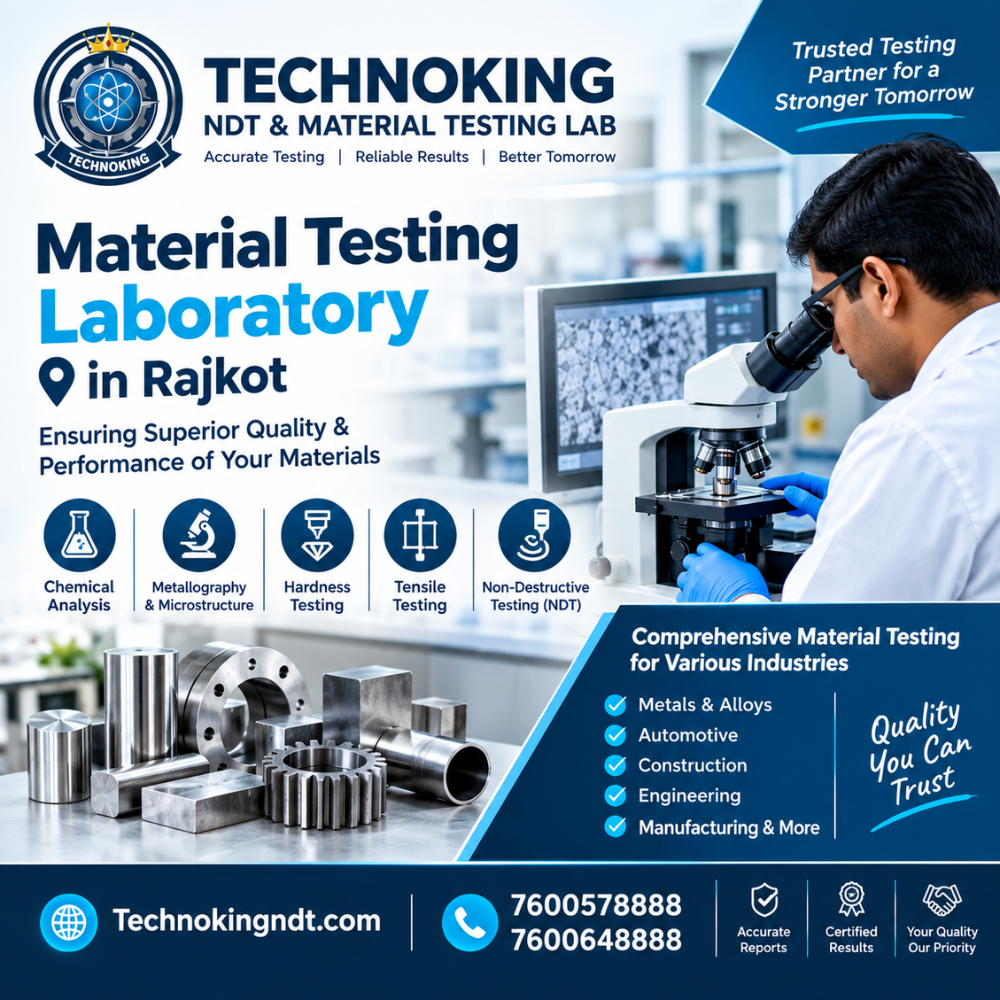
A professional Metal Testing Lab in Rajkot helps manufacturers evaluate the properties of metallic materials and determine whether they meet the required quality criteria. Testing can be performed on raw materials, samples, finished components, or production batches, depending on the requirements.
Metal testing is especially valuable for industries that manufacture precision components, castings, machined parts, and load-bearing products. It supports quality verification at different stages of manufacturing, helping businesses identify material-related problems before products enter service.
Testing requirements should be defined according to the material grade, component design, industry standards, and customer specifications. Clear testing procedures also help improve consistency between suppliers, manufacturers, and quality control teams.
Role of a Metal Testing Laboratory in Quality Control
Industrial quality control involves more than inspecting the appearance of a finished product. Materials may contain variations that are not visible to the naked eye. Testing provides measurable information that helps quality teams evaluate whether materials satisfy defined requirements.
A dependable Metal Testing Laboratory in Rajkot can assist manufacturers with material verification, production inspection, and quality documentation. Laboratory reports can help technical teams review results, compare measurements with acceptance criteria, and determine whether additional investigation is required.
Important quality control activities include:
- Verification of material grades and specifications.
- Evaluation of mechanical properties.
- Assessment of hardness and strength requirements.
- Investigation of material failures or unexpected performance.
- Comparison of test results with applicable standards.
- Documentation of test results for quality records and customer requirements.
Testing alone does not automatically guarantee that a product meets every quality or regulatory requirement. Results must be interpreted against the appropriate specifications, and the laboratory’s capabilities should match the required test methods.
Conclusion
Material evaluation is an important part of maintaining industrial quality, product reliability, and manufacturing consistency. From engineering components and castings to fabricated products and industrial machinery, appropriate testing helps businesses understand material properties and verify compliance with defined requirements.
Choosing a technically capable laboratory with suitable equipment, qualified personnel, and clear reporting practices can make material verification more effective. By including appropriate testing procedures in their quality control processes, manufacturers can reduce material-related risks, improve confidence in their products, and support long-term industrial performance.