
Google Introduces Gemini 3.6 Flash, 3.5 Flash-Lite, and 3.5 Flash Cyber to Accelerate Enterprise AI Innovation
Introduction
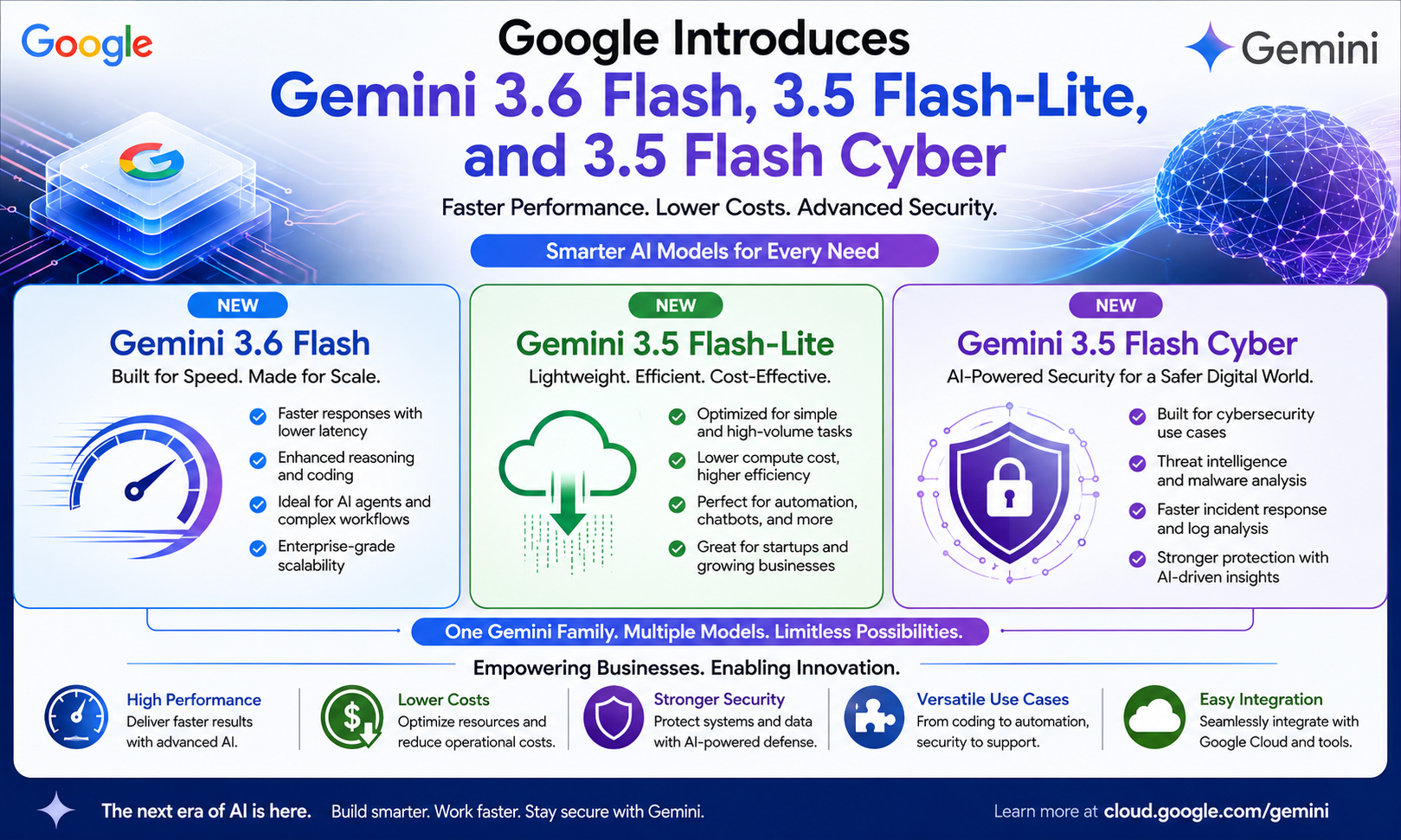
Google has expanded its Gemini family of artificial intelligence models with the introduction of Gemini 3.6 Flash, Gemini 3.5 Flash-Lite, and Gemini 3.5 Flash Cyber. These new models are designed to deliver faster performance, lower operating costs, and specialized capabilities for businesses, developers, and cybersecurity professionals. The announcement demonstrates Google's continued commitment to making AI more practical, scalable, and accessible across a wide range of industries. As organizations increasingly rely on AI to automate workflows, improve customer experiences, and strengthen security, the demand for efficient and purpose-built models continues to grow. Google's latest Gemini releases address these needs by offering models optimized for speed, affordability, and security-focused applications.
A New Generation of Fast AI Models
The latest Gemini models represent Google’s strategy of building AI systems tailored to different use cases instead of relying on a single general-purpose model. Businesses often require AI that delivers quick responses while maintaining high accuracy and reasonable operational costs.
Gemini 3.6 Flash has been developed for organizations that need powerful AI capabilities with low latency. It supports rapid reasoning, coding assistance, content generation, data analysis, and AI agent workflows while reducing response times for users.
This makes the model suitable for enterprise applications where speed directly impacts productivity and customer satisfaction.
Gemini 3.6 Flash Delivers Faster Performance
Gemini 3.6 Flash focuses on balancing intelligence with efficiency. The model has been optimized to process complex requests quickly while maintaining reliable output quality.
Key advantages include:
- Faster response generation
- Improved coding capabilities
- Enhanced reasoning performance
- Lower inference latency
- Better enterprise scalability
- Optimized cloud deployment
These improvements enable organizations to build AI-powered products that feel more responsive while handling large numbers of simultaneous users.
Cost-Efficient AI with Gemini 3.5 Flash-Lite
Many organizations want AI solutions that remain affordable as usage grows. Gemini 3.5 Flash-Lite addresses this requirement by offering an efficient model designed for lightweight workloads.
The model is particularly useful for:
- Customer support automation
- FAQ systems
- Document summarization
- Text classification
- Translation tasks
- Basic content generation
Because Flash-Lite consumes fewer computing resources, businesses can deploy AI services at scale without significantly increasing operational expenses.
This makes it especially attractive for startups, educational institutions, and organizations managing high-volume AI requests.
Gemini 3.5 Flash Cyber Targets Security Operations
Cybersecurity has become one of the fastest-growing applications of artificial intelligence. Organizations face increasingly sophisticated threats that require continuous monitoring and rapid analysis.
Gemini 3.5 Flash Cyber has been designed specifically for cybersecurity professionals.
Potential applications include:
- Threat intelligence analysis
- Malware investigation
- Security incident response
- Vulnerability assessment
- Log analysis
- Risk detection
- Security report generation
The specialized model helps security teams process enormous amounts of security data more efficiently while accelerating investigation workflows.
Supporting AI Agents
One of Google’s major priorities is enabling AI agents capable of completing multi-step tasks with minimal human intervention.
The new Gemini models provide stronger foundations for intelligent agents that can:
- Analyze business documents
- Retrieve information
- Write software code
- Generate reports
- Plan workflows
- Execute repetitive tasks
- Assist customer service representatives
As AI agents become increasingly common, organizations require models that combine speed, reasoning, and reliability.
Gemini 3.6 Flash has been optimized to meet these growing demands.
Improved Coding Assistance
Software development remains one of the most popular applications of generative AI.
The latest Gemini models offer improvements in:
- Code generation
- Bug detection
- Code explanation
- Documentation creation
- Refactoring suggestions
- Programming assistance across multiple languages
Developers can use these capabilities to accelerate software projects while reducing repetitive programming tasks.
Enterprise AI Adoption Continues to Grow
Businesses worldwide continue investing heavily in AI technologies to improve productivity and gain competitive advantages.
Industries adopting enterprise AI include:
- Healthcare
- Banking
- Manufacturing
- Retail
- Telecommunications
- Logistics
- Education
- Government
The introduction of multiple Gemini models gives organizations greater flexibility when selecting AI solutions that match their performance and budget requirements.
Lower Costs for Large-Scale Deployments
One of the biggest challenges in enterprise AI deployment is managing infrastructure costs.
By introducing Flash-Lite alongside Gemini 3.6 Flash, Google allows businesses to choose models based on workload complexity.
Organizations can reserve high-performance models for advanced reasoning tasks while using lightweight models for routine automation.
This approach helps optimize cloud spending without sacrificing user experience.
AI Security Remains a Priority
As AI systems become more powerful, security remains an essential consideration.
Google continues investing in:
- Responsible AI development
- Privacy protection
- Model safety
- Security testing
- Transparency
- Enterprise governance
Gemini 3.5 Flash Cyber further strengthens Google’s AI portfolio by providing specialized support for cybersecurity professionals working to protect digital infrastructure.
Benefits for Developers
Developers benefit from the latest Gemini releases through improved APIs and optimized model performance.
Potential advantages include:
- Faster application development
- Reduced infrastructure costs
- Lower latency
- Better coding support
- Flexible deployment options
- Reliable enterprise performance
These improvements make it easier to integrate AI into web applications, mobile apps, cloud services, and business software.
Expanding Google’s AI Ecosystem
The introduction of these models also strengthens Google’s broader AI ecosystem, including Google Cloud, Vertex AI, Workspace, Android, and developer tools.
Organizations using Google’s cloud infrastructure can leverage Gemini models across multiple business processes while maintaining centralized AI management.
The continued expansion of the Gemini ecosystem demonstrates Google’s long-term commitment to enterprise AI innovation.
Conclusion
Artificial intelligence continues evolving at an extraordinary pace, and businesses increasingly require AI systems that are fast, efficient, secure, and cost-effective. With the launch of Gemini 3.6 Flash, Gemini 3.5 Flash-Lite, and Gemini 3.5 Flash Cyber, Google is addressing these demands by offering specialized models for enterprise productivity, lightweight automation, and cybersecurity.
The new releases provide organizations with greater flexibility in selecting AI solutions that align with their operational goals and budgets. Faster inference, stronger coding capabilities, optimized deployment, and dedicated cybersecurity features position the latest Gemini models as valuable tools for businesses seeking to accelerate digital transformation.
As AI adoption expands across industries, Google’s continued investment in specialized Gemini models is expected to help developers, enterprises, and security professionals build more intelligent applications while improving efficiency, scalability, and innovation in the years ahead.