
Made in India: IISc’s New Method Transforms Quantum Sensor Applications-Research Enables Sensors to Travel Inside Cells
Introduction
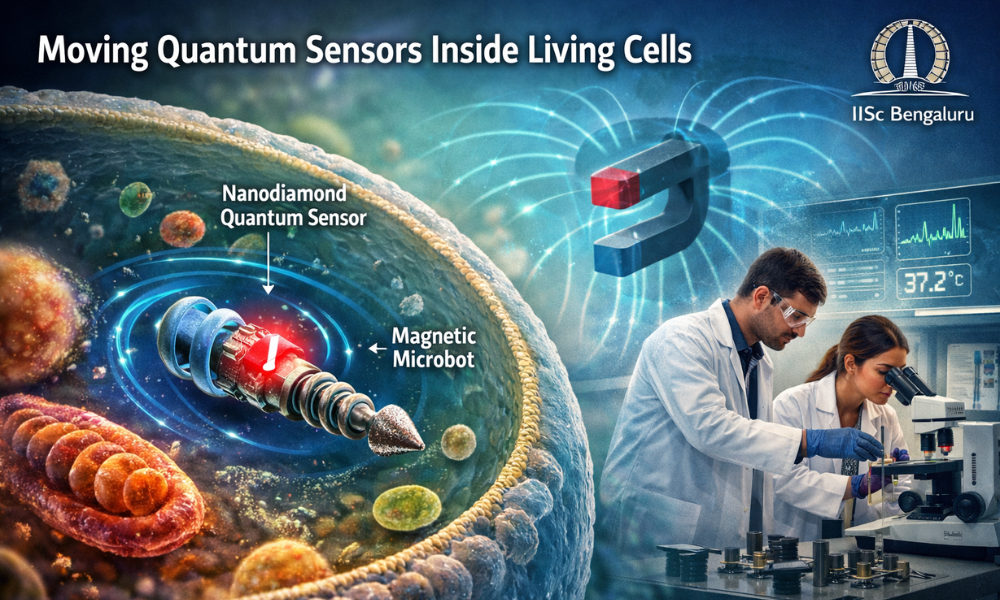
In a major scientific breakthrough, researchers at the Indian Institute of Science (IISc), Bengaluru, have developed an innovative technique to move quantum sensors inside living cells with high precision. This advancement addresses a long-standing challenge in the field of quantum sensing—how to control and position extremely small sensors within complex biological environments. The new method combines nanodiamond-based quantum sensors with magnetically controlled microbots, enabling scientists to navigate sensors through dense cellular structures safely and effectively.
What Are Quantum Sensors?
Quantum sensors are ultra-sensitive devices that use the principles of quantum mechanics to measure physical properties such as temperature, magnetic fields, and pressure at extremely small scales. In this study, researchers used nanodiamonds embedded with nitrogen-vacancy (NV) centers, which are defects in the diamond structure that respond to environmental changes.
These NV centers act as tiny probes that can detect:
- Minute temperature variations
- Magnetic field fluctuations
- Chemical changes inside cells
Because of their high sensitivity, quantum sensors have become an essential tool in advanced research areas like biophysics, material science, and medicine.
The Challenge: Navigating Inside Cells
One of the biggest obstacles in using quantum sensors for biological applications has been precise control over their movement. Inside a living cell, particles are constantly jostled by molecules in a phenomenon known as Brownian motion. This random movement makes it difficult to
- Keep the sensor stable
- Position it at a specific location
- Collect accurate data
Previously, scientists relied on optical tweezers (laser-based tools) to manipulate tiny particles. However, these methods have limitations:
- High-intensity lasers can damage sensitive biological tissues
- Limited control in dense environments
- Difficulty in long-distance navigation within cells
The Breakthrough: Magnetic Microbots
To overcome these challenges, IISc scientists introduced a novel solution—magnetically driven microbots. These microbots are extremely small structures that can be attached to nanodiamond quantum sensors.
How the System Works:
- The nanodiamond sensor is coupled with a tiny magnetic microbot
- External magnetic fields are applied to control movement
- The microbot rotates and moves forward in a corkscrew-like motion
- Scientists can guide the sensor in three dimensions with high precision
This approach allows researchers to actively steer the sensor, rather than letting it drift randomly inside the cell.
Key Advantages of the New Method
The IISc team’s innovation offers several important benefits:
- Precise Navigation
Scientists can now guide quantum sensors to exact locations inside cells, enabling targeted measurements.
- Reduced Cellular Damage
Unlike laser-based techniques, magnetic control does not expose cells to harmful radiation.
- Improved Measurement Accuracy
By stabilizing the sensor, the method reduces noise caused by random motion, resulting in more reliable data.
- Real-Time Monitoring
Researchers can continuously track changes inside cells without interrupting biological processes.
Potential Applications
This breakthrough opens up exciting possibilities across multiple scientific and medical fields:
-
Cancer Research
The ability to monitor cellular environments in real time could help scientists do the following:
- Detect early signs of cancer
- Study tumor behavior at the microscopic level
- Improve targeted therapies
-
Ageing and Cell Biology
Understanding how cells change over time is crucial for aging research. Mobile quantum sensors can track:
- Cellular stress
- Protein activity
- Intracellular changes
-
Disease Detection
The technology can be used to detect Reactive Oxygen Species (ROS), which are linked to various diseases, including
- Neurodegenerative disorders
- Cardiovascular diseases
-
Drug Delivery Systems
In the future, similar microbot systems could be used to:
- Deliver drugs directly to specific cells
- Monitor the effectiveness of treatments in real time
Why This Matters Globally
The IISc breakthrough represents a significant step toward next-generation biomedical tools. As the world moves toward personalized medicine, technologies that allow precise monitoring at the cellular level will become increasingly important.
This innovation also highlights India’s growing leadership in advanced scientific research, particularly in fields like
- Quantum technology
- Nanotechnology
- Biomedical engineering
By combining these disciplines, IISc researchers have demonstrated how interdisciplinary approaches can lead to transformative discoveries.
Key Highlights (Quick Points)
- IISc scientists developed a method to move quantum sensors inside living cells
- Uses nanodiamond sensors with nitrogen-vacancy (NV) centers
- Controlled by magnetically driven microbots
- Overcomes challenges of Brownian motion
- Safer than traditional laser-based techniques
- Enables real-time, precise cellular measurements
- Has applications in cancer research, ageing, and disease detection
Future Outlook
While the research is still in its early stages, the potential for real-world applications is immense. Future developments could include:
- Clinical use in diagnostics
- Integration with AI for data analysis
- Development of autonomous microbots
As the technology matures, it could revolutionize how scientists study living systems and treat diseases.
Conclusion
The development of a new method to move quantum sensors inside living cells marks a major milestone in scientific innovation. By combining nanodiamond-based sensors with magnetically controlled microbots, IISc scientists have overcome a critical barrier in quantum sensing. This breakthrough not only enhances the precision and safety of cellular measurements but also paves the way for groundbreaking applications in medicine and research.
As scientists continue to refine this technology, it holds the promise of transforming healthcare, enabling earlier disease detection, and unlocking deeper insights into the mysteries of life at the microscopic level.